Complete guide to basic plumbing in your home
Last updated 13 June 2026 · 10 min read
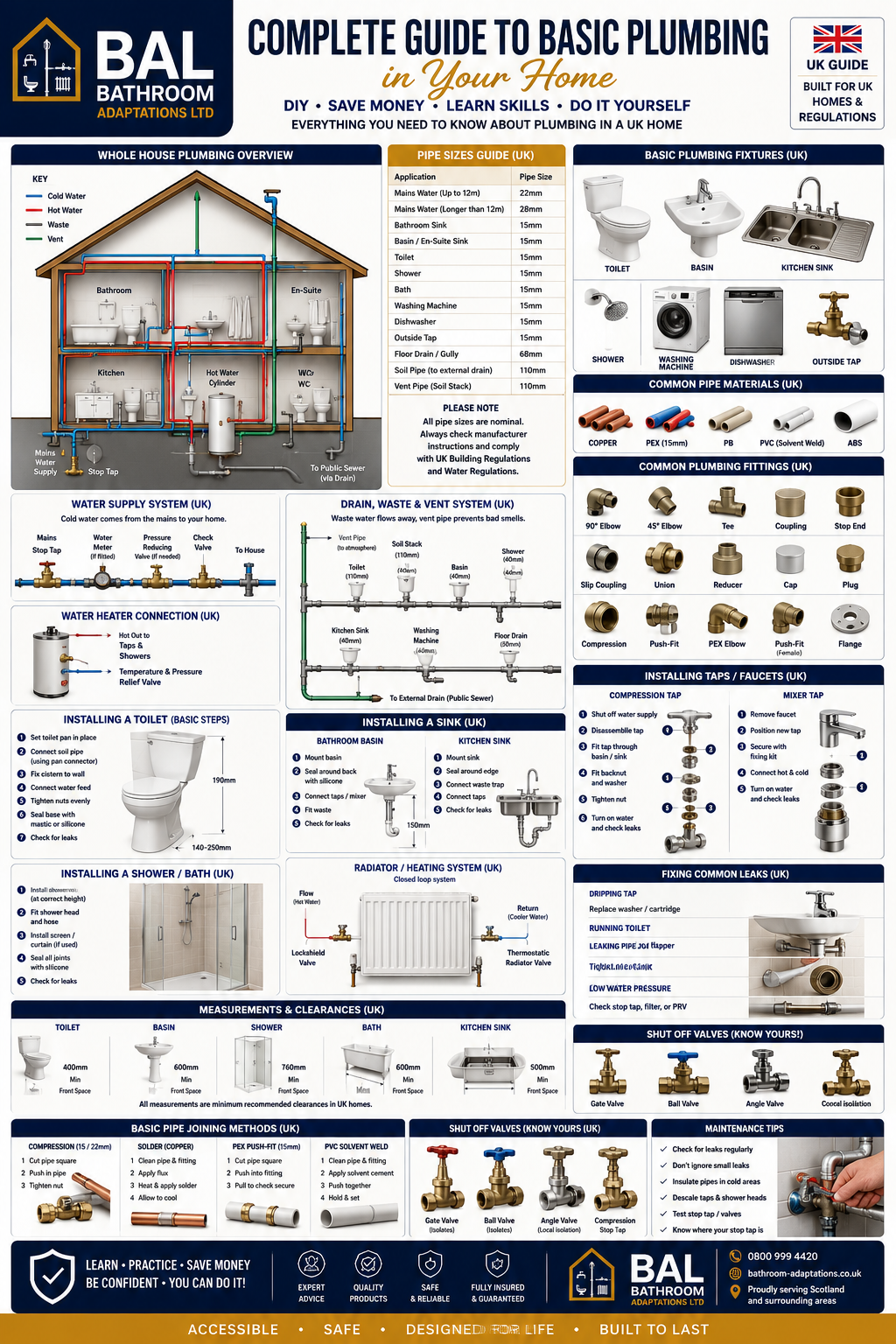
Understanding the basics of how your home's plumbing works makes it easier to do small jobs yourself, spot problems early and have an informed conversation with a tradesperson.
This UK-focused visual guide covers the whole-house plumbing layout, typical pipe sizes, common fittings and materials, shut-off valves, installing core fixtures and dealing with the most common leaks.
Step-by-step summary
Step 1
Know your stop tap
Locate the main stop tap so you can shut off the water in an emergency.
Step 2
Understand pipe sizes
15mm to fixtures, 22mm mains, 40mm waste, 110mm soil pipes.
Step 3
Identify your fittings
Compression, push-fit, solder and solvent weld each suit different jobs.
Step 4
Respect clearances
Toilet 400mm, basin 600mm, shower 760mm minimum front space.
Step 5
Test before you finish
Always check for leaks at every joint after running water through the system.
Whole house plumbing overview
Cold water enters the property through the mains supply and stop tap, then feeds the cold outlets and the hot water cylinder. Hot water flows from the cylinder to taps, baths and showers. Waste leaves through traps and pipework into the soil stack and out to the public sewer.
A vent pipe to the atmosphere keeps the drainage system at air pressure so traps do not get sucked dry, which is what stops bad smells coming back up into the room.
UK pipe sizes at a glance
Pipe sizes are nominal. Always check manufacturer instructions and comply with UK Building Regulations and Water Regulations.
- Mains water (up to 12m): 22mm
- Mains water (longer than 12m): 28mm
- Bathroom sink, basin, toilet, shower, bath: 15mm
- Washing machine, dishwasher, outside tap: 15mm
- Floor drain / gully waste: 68mm
- Soil pipe to external drain: 110mm
- Vent pipe / soil stack: 110mm
Common pipe materials and fittings
Most UK homes use a mix of copper and plastic pipework. Copper is durable and tidy on show; PEX and push-fit are quicker for hidden runs and repairs. Soil and waste pipes are typically PVC or ABS.
- Copper — soldered or compression joints
- PEX (15mm) — flexible plastic, push-fit friendly
- PB (polybutylene) — flexible, push-fit
- PVC (solvent weld) — waste and soil
- ABS — waste and soil
- Fittings: 90° and 45° elbows, tees, couplings, stop ends, unions, reducers, caps, plugs, compression, push-fit and flanges
Shut-off valves — know yours
Knowing which valve isolates which part of the system saves time and water damage in an emergency.
- Gate valve — isolates a section, fully open or closed
- Ball valve — quick quarter-turn isolation
- Angle valve — local isolation at a fixture
- Compression stop tap — main or branch isolation
Installing core fixtures
The basics are similar across toilets, basins, sinks and showers: position, connect, seal, tighten and check for leaks.
- Toilet: set pan, connect soil pipe with a pan connector, fix cistern, connect water, tighten, seal base, check for leaks (toilet height typically around 190mm, 140–250mm projection).
- Bathroom basin: mount, seal around the back with silicone, connect taps and waste, check for leaks (around 150mm clearance under the basin).
- Kitchen sink: mount, seal around the edge, fit waste trap and taps, check for leaks.
- Shower / bath: install showerway at correct height, fit shower head and hose, install screen or curtain, seal all joints with silicone, check for leaks.
Fixing common leaks
Most domestic leaks are small and fixable without specialist tools, as long as you isolate the water first.
- Dripping tap — replace the washer or cartridge
- Running toilet — check and replace the flapper / fill valve
- Leaking pipe joint — tighten the compression nut or re-make the joint
- Low water pressure — check stop tap, filter or pressure reducing valve
Recommended UK clearances
These are minimum recommended clearances for comfort and access in UK homes.
- Toilet: 400mm minimum front space
- Basin: 600mm minimum front space
- Shower: 760mm minimum front space
- Bath: 600mm minimum front space
- Kitchen sink: 500mm minimum front space
Maintenance tips
A few habits keep plumbing trouble-free and head off expensive repairs.
- Check for leaks regularly under sinks and around fixtures
- Do not ignore small leaks — they always get worse
- Insulate pipes in cold or unheated areas
- Descale taps and shower heads to maintain flow
- Test stop tap and isolation valves so they do not seize
- Know where your stop tap is before you need it
Frequently asked questions
What size pipe do I need for a bathroom tap or toilet?
Most UK bathroom fixtures — basins, toilets, showers, baths, washing machines and dishwashers — are fed by 15mm pipe. Mains feeds into the property are usually 22mm, or 28mm for longer runs.
What is the difference between compression and push-fit fittings?
Compression fittings use a brass nut and olive squeezed onto the pipe to make a watertight seal. Push-fit uses an internal grab ring and O-ring so the pipe simply pushes into the fitting. Push-fit is faster; compression is often preferred where joints will be on permanent show.
Where is my main stop tap usually?
In UK homes it is most commonly under the kitchen sink, in a utility room or near where the mains enters the property. There is also an external stop tap at the boundary, usually under a small cover.
Do I need to comply with regulations for DIY plumbing?
Yes. Domestic plumbing in the UK must comply with the Water Supply (Water Fittings) Regulations and relevant Building Regulations. Gas and unvented hot water work must be done by a suitably qualified person.
Related guides
Need help with the job itself?
We install accessible bathrooms, walk-in showers and wet rooms across Central Scotland.