How bathroom ventilation works
Last updated 13 June 2026 · 6 min read
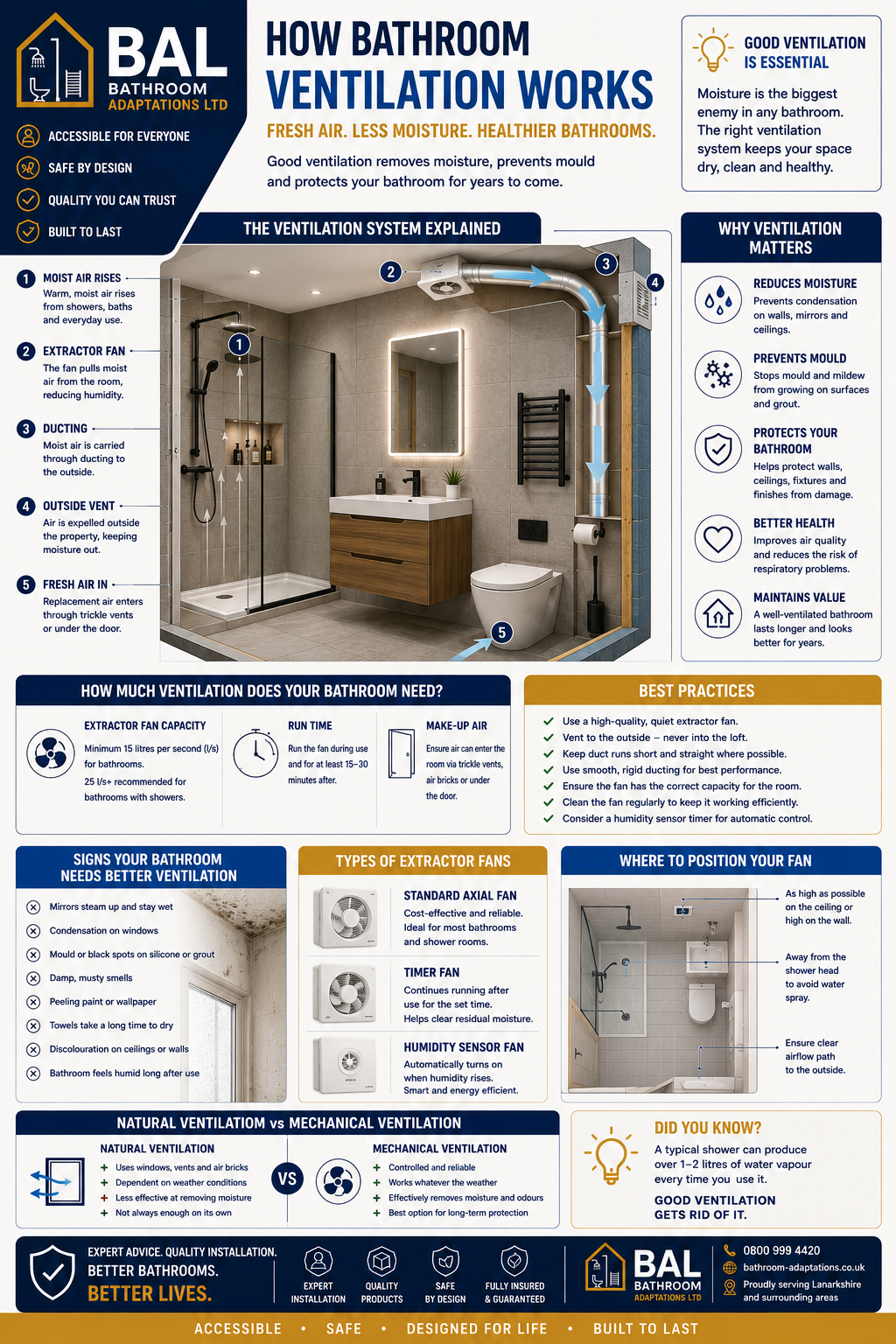
Good bathroom ventilation removes moisture before it settles on walls, ceilings, mirrors and grout. That matters because lingering moisture is one of the main reasons mould, blackened silicone and peeling finishes keep returning.
This guide explains what a ventilation system actually does, how much extraction is usually needed and what to check if a bathroom still feels damp after use.
Step-by-step summary
Step 1
Moist air rises
Warm, moisture-laden air builds up quickly during showers and baths.
Step 2
The fan extracts it
An extractor fan pulls humid air out of the room at source.
Step 3
Ducting carries it away
The moisture travels through ducting to the outside, not into a loft void.
Step 4
Fresh air enters
Make-up air comes in through a door undercut, trickle vent or similar inlet.
Step 5
Run-on time clears the room
The fan should keep running after use so surfaces have time to dry.
Why ventilation matters so much
Ventilation protects more than comfort. It helps reduce condensation, mould, musty smells and slow moisture damage to plaster, paint, ceilings and joinery.
In wet rooms and walk-in showers, it is especially important because more of the room can be exposed to warm water vapour every day.
- Reduces condensation on mirrors and windows
- Helps stop mould on silicone and grout
- Protects wall finishes and ceilings from damp damage
- Improves air quality and day-to-day comfort
Signs your bathroom needs better extraction
If surfaces stay wet for a long time after use, the room is probably not clearing moisture fast enough. The problem may be a weak fan, poor ducting, no make-up air or simply not running the fan for long enough.
- Mirrors stay steamed up for a long time
- Condensation forms on windows or walls
- Mould appears on grout, ceilings or silicone
- Paint peels or the room smells damp
- The bathroom still feels humid long after showering
Best-practice installation tips
Fan performance depends on the full system, not just the unit itself. Short, smooth duct runs and an outlet to the outside make a big difference.
- Vent to the outside, not into the loft.
- Keep duct runs short and as straight as possible.
- Use rigid or smooth ducting where practical.
- Fit the fan high on the wall or ceiling and away from direct spray.
- Let the fan run on after use or use a humidity sensor.
Frequently asked questions
How long should a bathroom fan run after a shower?
A common rule is around 15 to 30 minutes after use, depending on the room and the moisture load.
Can an extractor fan vent into the loft?
It should vent to the outside. Dumping moist air into the loft can create damp and mould problems elsewhere in the property.
Why does mould keep coming back even after cleaning?
Because moisture is still building up faster than the room can dry. Ventilation problems often sit underneath repeat mould issues.
Related guides
Need help with the job itself?
We install accessible bathrooms, walk-in showers and wet rooms across Central Scotland.